Lucky Star
Playing cards originated in China during the Tang and Song dynasties (9th–11th c.), most likely derived from paper money games, and progressively spread westward along the Silk Road. They reached the Islamic world by the 13th century and Europe by the late 14th century, where the suits (hearts, spades, clubs, diamonds) were later adapted from earlier Chinese and Mamluk prototypes. If this historical record is correct, then the very concept of the playing card is originally Chinese, and the later Western card traditions are culturally transformed descendants of this invention. In contemporary China, card games remain deeply embedded in the social fabric and are played in parks, community centers, street corners, and teahouses. Games such as Dou Dizhu, Mahjong variants (tile-card hybrids), Shengji, and tractor games are central to collective leisure and are strongly associated with intergenerational knowledge, strategic thinking, public sociability, and emotional expression. These games are simultaneously cooperative and competitive, highly structured yet expressively flexible, and they reveal the micro-gestures, rhythms of anticipation, alliances, rivalries, and nonverbal communication that characterize complex human interaction.
At the same time, card games have become a site of technological experimentation. With the rise of artificial intelligence and robotics, China is now at the forefront of developing machines capable of learning, analyzing, and even playing culturally rooted games. The Beijing Robot Congress 2025, for example, includes demonstrations of robots trained to play Mahjong and Dou Dizhu through machine learning, probabilistic modeling, and facial recognition. This emergence of AI in spaces traditionally reserved for human strategy and sociality raises essential questions: What happens when machines enter one of the most human, face-to-face, emotionally expressive forms of interaction? Can AI understand hesitation, bluff, empathy, and the embodied timing of play? What is lost, and what is reinvented, when the circle of players expands to include robotic agents? We are situated at a transitional moment, between the communal ritual of traditional play and the technologically mediated future of interaction.
It is within this historical and cultural context that the photographic and video-based series Lucky Star was developed in Beijing in 2025. The title references China’s emblematic symbol of fortune and destiny, the red star as well as the notion of “lucky star” in games of chance. The series was created using an Insta 360°/3D camera placed at the precise center of a card table, a position almost never used in visual documentation. While 360° cameras are typically employed for panoramic landscape views or VR tourism, in this project the camera becomes a social instrument that records play from within rather than from outside. This configuration allows for the equal visibility of every participant and captures the inner dynamic of the game: facial expressions, micro-gestures, shifts of attention, tactile movements, communicative silences, and affective exchanges. The camera does not simply document the surface of the game; it reveals the invisible architectures of interaction and the choreography of decision-making.
The images produced by this method take the shape of spheres, visually evoking both celestial bodies and Renaissance domes. The series proposes a contemporary reinterpretation of illusionistic ceiling painting (quadratura, cupola frescoes), where historically viewers gazed upward at angels and cherubs occupying a heavenly realm. In Lucky Star, these celestial figures are replaced by Chinese card players, transforming ordinary social play into a cosmic theatre. For this reason, the works are designed to be exhibited on the ceiling, so that the viewer must look upward into a rotating sphere of human interaction.
Beyond static images, the project involves 360° video recordings from which the stills are extracted. Using TouchDesigner as the primary compositional and spatial mapping tool, the work will be adapted to full-dome, 360-degree projection, allowing the spherical video to function as a navigable, enveloping field rather than a fixed image. These videos are currently in post-production and will form an animated work in which the motion is internal to the spherical frame. Instead of moving the external camera through the environment, the viewpoint travels inside the globe from one player’s face to another, allowing the audience to encounter each participant’s expression, mimicry, and emotional modulation. The internal animation makes it possible to reveal micro-dynamics of communication that are otherwise imperceptible. It transforms the simple act of playing cards into a perceptual and spatial experience, making visible the hidden logics of attention, strategy, and collective cognition.
The final form of presentation will extend beyond ceiling installation into immersive projection. These spherical video sequences are intended to be screened in environments akin to geodesic or “geode” cinemas, full-dome projection spaces historically used for astronomy, simulation, or panoramic illusion. In this context, the viewer becomes surrounded by the sphere rather than observing it from a distance, collapsing the boundary between observer and participant. This format mirrors the circular structure of the card table itself and echoes the historical trajectory from sacred ceilings to contemporary immersive media.
By linking the deep history of playing cards (Chinese in origin) with the contemporary social reality of Chinese communal play, and by situating this within the emerging future of AI-driven robot opponents showcased in Beijing Robot Congress 2025, Lucky Star positions itself at the intersection of tradition, technology, and perception. It treats the card table as a microcosm of cultural evolution: from ancient paper games to globalized suits, from neighborhood parks to machine learning algorithms, and from Renaissance illusion to immersive spherical video. This project seeks to articulate a continuous dialogue between the historical origins of the playing card, its contemporary social practices, and its future within emerging forms of human–robot interactions and coexistence. Additional photographs and video frames will be integrated as the work continues to develop.
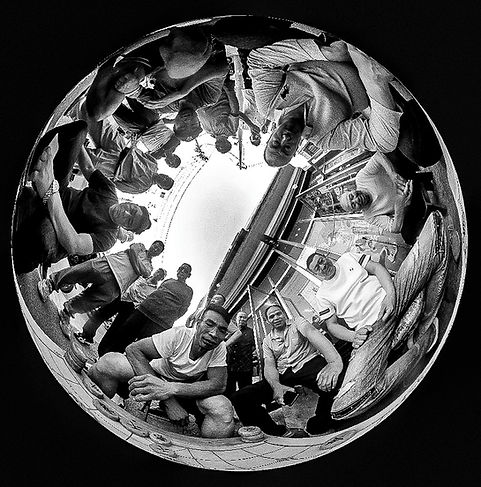
"Lucky Star"
(Insta 360° camera)
Beijing, 2025
"Éclairage” is a 2’21’’ extract from an 8’15’’ video that will be looped in its entirety. Conceived as an art installation, it will function as the atmospheric light source for the night photographs from the Lucky Star series.
The term éclairage originates from the French verb éclairer, “to illuminate” or “to make visible,” which derives from éclair, meaning “lightning.” In Old French, esclaire referred specifically to the sudden flash produced by a storm. The root ultimately comes from the Latin clārāre (“to make bright”) and clārus (“clear, shining”). Before acquiring its technological sense in the eighteenth and nineteenth centuries denoting lighting systems, theatrical illumination, and apparatus, éclairage retained the connotation of a natural, violent, and revelatory light. In this work, thunder and lightning reclaim their original function as elemental agents of illumination, becoming the ambient lighting system of the exhibition space itself.
Recorded in the street without staging or direction, the video captures a Chinese construction worker singing under summer rain at the end of a workday. An involuntary synchronisation occurs between the worker’s voice, the rumble of thunder, and the mechanical resonance of a construction crane, while electrical wires transform the urban environment into an open-air acoustic instrument. The natural world becomes the lighting system; the storm becomes the score.
This moment of unplanned harmony reveals an affective counterpoint within contemporary Chinese urbanisation. Construction workers, primarily internal migrants from distant provinces, leave their families for months or years to live on-site in temporary dormitories, labouring in anonymity to construct the expanding city. Their presence is infrastructural yet invisible; their voices rarely penetrate the aesthetic field. In “Éclairage,” the worker’s spontaneous singing punctures this invisibility and produces a brief yet profound “burst of joy,” not as entertainment but as an existential gesture.
Éclairage
Video installation, 8’15’’ (looped)
Excerpt shown: 2.21mn
2025, Beijing.
Gallery Representation: http://www.seegallery.net/
Research Affiliation: https://www.aliusresearch.org/
NeuroArts Resource Center Profile:
https://www.neuroartsresourcecenter.com/profile/france-lerner